Buying property in Italy in 2026

Table of Contents
1.Why Buyers Are Looking at Italy in 2026
2.Can Foreigners Buy Property in Italy?
4.Understanding the Italian Property Buying Process
5.Property Prices in Italy in 2026
6.Taxes and Costs When Buying Property in Italy
7.Sending Money to Italy for a Property Purchase
8.Protecting Your Exchange Rate Before Completion
10.How Overseas Payments Can Help
Buying property in Italy continues to appeal to international buyers looking for lifestyle, culture, investment potential, retirement options and second homes abroad.Whether you are considering a villa in Tuscany, an apartment in Rome, a property near Lake Como, a countryside home in Umbria, or a coastal property in Puglia, buying in Italy requires careful planning.The Italian property process is different from the UK process.
Buyers need to understand the legal steps, taxes, documentation, payment timings and currency exchange implications before sending money overseas.For UK buyers, one of the most important parts of the process is converting pounds into euros. If you are buying a property in Italy in 2026, the GBP/EUR exchange rate can have a major impact on the final sterling cost of your purchase.
At Overseas Payments, we help clients arrange large international transfers, convert pounds into euros, and plan property payments with support from a currency specialist.
1. Why Buyers Are Looking at Italy in 2026
Italy remains one of Europe’s most attractive property destinations for overseas buyers.
The appeal is easy to understand. Italy offers historic cities, coastal regions, countryside homes, ski areas, lakeside property, food, culture and lifestyle. It also has major international cities such as Milan and Rome, as well as popular second-home regions including Tuscany, Umbria, Liguria, Puglia and the Italian Lakes.
In 2026 Italy continues to attract buyers for several reasons:Lifestyle and retirement Second homes and holiday properties Investment and rental potential Relocation from the UK or other countries Access to major European cities Interest from higher-net-worth buyers in Milan and Rome Comparatively broad price ranges across different regionsProperty prices vary significantly by location. Prime areas such as Milan, Rome, Lake Como, Tuscany and the Amalfi Coast can be expensive, while some rural or southern regions may offer lower entry prices.Recent market data from Immobiliare.
it showed Italian residential asking prices in May 2026 were up 4.37% compared with May 2025, with large regional differences. Trentino-Alto Adige had the highest regional asking prices at €3,707 per square metre, while Calabria had the lowest at €960 per square metre. For wealthier buyers, Milan has also become more prominent.
The Guardian reported in 2026 that Italy’s flat-tax regime has helped attract affluent foreign residents, with Milan becoming increasingly popular among wealthy international buyers.
2. Can Foreigners Buy Property in Italy?
Yes, many foreign buyers can purchase property in Italy, but the rules depend on nationality and residence status. According to guidance from the Italian Embassy in Oslo, citizens from EU and EFTA countries are not subject to restrictions when buying property in Italy.
The same guide notes that non-EU citizens who have lived in Italy for less than three years generally need a valid residence permit. It also makes clear that buying property in Italy does not automatically grant residency or citizenship. For UK buyers after Brexit, it is important to get proper legal advice before purchasing. The ability to buy a property is separate from the right to live in Italy long term.
Before buying, you should confirm: Whether you are eligible to buy Whether you need a visa or residence permit How long you can stay in Italy each year Whether the property purchase affects your tax position Whether you need local legal advice Whether you need an Italian bank account Overseas Payments can help with currency exchange and international payments, but legal, tax and residency questions should be checked with qualified advisers.
3. Getting Your Codice Fiscale
A codice fiscale is an Italian tax identification number.You will usually need one before buying property in Italy.The Italian Embassy guide explains that a foreign buyer must obtain a codice fiscale from the Italian tax authorities, the Agenzia delle Entrate.
The guide says this can be requested by presenting identification documents and a reason for the request, such as a property purchase. You may need a codice fiscale for: Signing contracts Opening an Italian bank account, Paying taxes and fees, Registering the property, Setting up utilities, Dealing with Italian public authorities It is sensible to arrange this early so that it does not delay the purchase process. In some cases, your estate agent, lawyer or appointed representative may help you obtain it.
4. Understanding the Italian Property Buying Process
The Italian property buying process can be different from the UK process. A typical purchase may involve:
Finding the property
Making an offer
Signing a preliminary agreement
Paying a deposit
Completing due diligence
Signing the final deed before a notary
Paying the balance and purchase taxes
Registering the property
Transferring utilities
The Italian Embassy guide outlines steps including obtaining a codice fiscale, opening an Italian bank account, searching for properties, inspecting properties, completing the purchase process, registering the property, paying taxes and transferring utilities.
The notary plays an important role in the Italian process. However, buyers should understand that the notary is a neutral public official, not your personal legal adviser. A separate legal adviser may help protect your interests, review documents and carry out checks. Before committing to a purchase, you should understand:
Who owns the property
Whether there are debts or charges on the property
Whether planning permissions and building records are correct
Whether renovations were properly authorised
What taxes and fees apply
When each payment is due
Whether your deposit is refundable
Whether the completion date is fixed For high-value purchases, independent legal advice is strongly recommended.
5. Property Prices in Italy in 2026
Italy is not one single property market. Prices vary significantly by region, city and property type. A luxury apartment in Milan or Rome will be priced very differently from a countryside home in Calabria, Abruzzo or Molise. Immobiliare.it data for May 2026 showed the highest average regional asking prices in Trentino-Alto Adige at €3,707 per square metre, while Calabria had the lowest average regional asking prices at €960 per square metre.
City-level data also showed Milan at €5,679 per square metre, Rome at €3,798 per square metre, Bologna at €3,825 per square metre and Naples at €3,031 per square metre. This matters for currency planning. If you are buying in a high-value area, the exchange rate can have a much bigger impact on your budget. For example, a buyer purchasing a €750,000 property in Italy needs to think carefully about the GBP/EUR exchange rate.
A small movement in the rate before completion could change the sterling cost by thousands of pounds. That is why buyers should consider the currency side early, not just at completion.

6. Taxes and Costs When Buying Property in Italy
When buying property in Italy, the purchase price is only one part of the total cost.
You may also need to budget for taxes, notary fees, estate agency fees, legal fees, translation costs and bank or mortgage costs. The tax treatment depends on several factors, including whether you are buying from a private seller or a developer, whether the property is a primary residence or second home, and whether VAT applies.
A 2026 Italian legal guide summarises key property taxes as including registration tax of 2% for a primary residence and 9% for a second home, and VAT of 4% for a primary residence and 10% to 22% for second homes or luxury property, with notary fees often listed separately. As a broad guide, buyers should budget for:
Registration tax or VAT
Morgage and cadastral taxes
Notary fees
Estate agency fees
Legal fees
Translation or interpreter costs
Survey or technical checks
Bank or mortgage costs
Currency exchange costs The exact figures can vary, so you should always get advice based on your specific property and circumstances. Overseas Payments does not provide tax or legal advice, but we can help you plan the currency exchange and international payment side of your purchase.
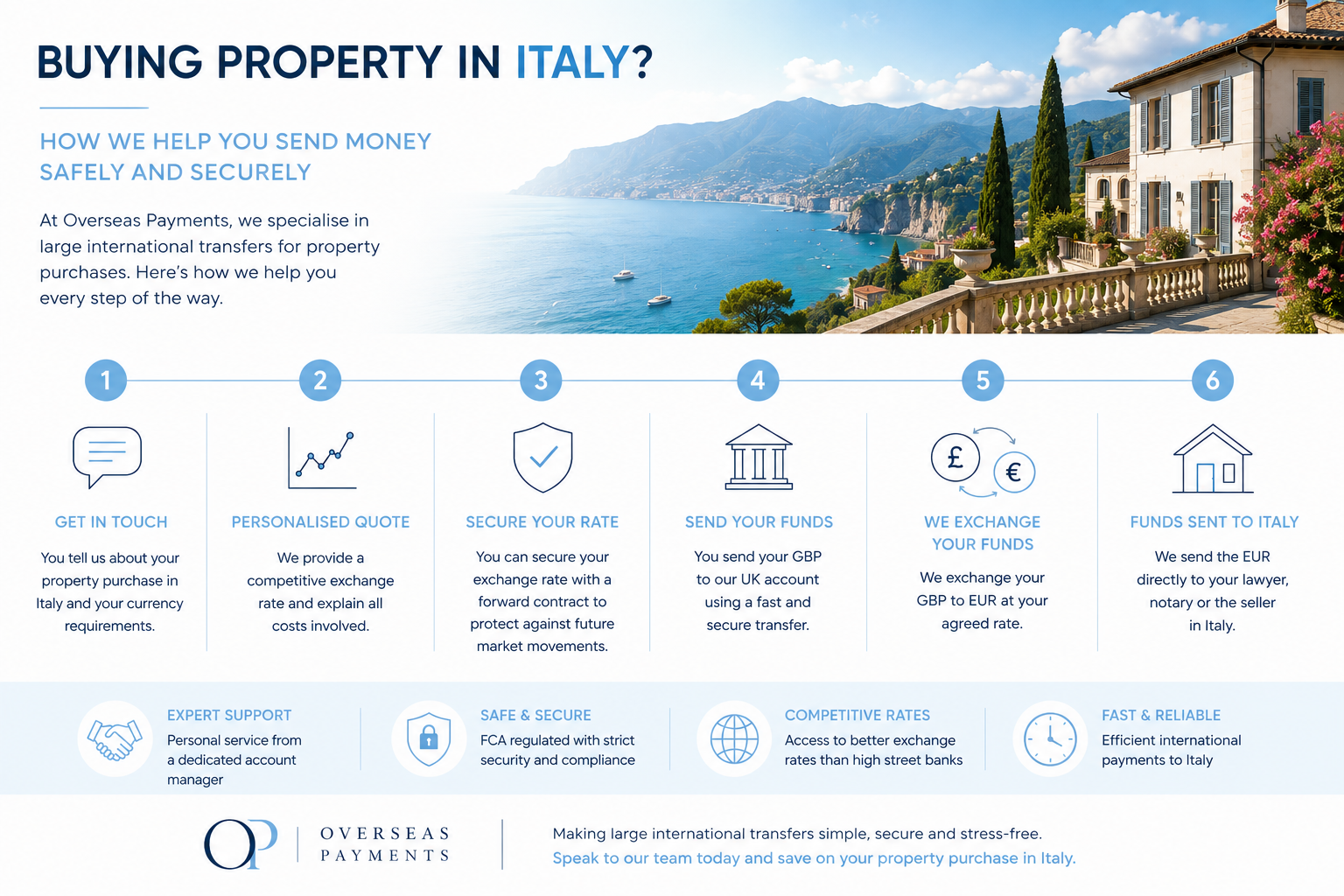
7. Sending Money to Italy for a Property Purchase
If you are buying property in Italy from the UK, you will usually need to convert pounds into euros. This may involve sending funds for:
Reservation deposits
Preliminary contract deposits
Final completion balances
Legal fees
Taxes
Renovation payments
Furniture or fit-out costs
How does this compare to the live market rate?
Are there any transfer fees?
Are there any receiving bank charges?
How much will arrive in euros?
How quickly can the payment be sent?
Can I speak to someone if there is an issue?
For larger purchases, the exchange rate is extremely important. Many buyers focus on transfer fees, but the exchange rate is usually the bigger cost when sending a large amount overseas. Before sending money to Italy, ask: What exchange rate am I being offered?
If you are sending £100,000, £250,000, £500,000 or more to Italy, comparing your bank’s exchange rate against a specialist currency provider can be worthwhile. Even a small difference in the rate can have a meaningful impact on the final cost.
8.Protecting Your Exchange Rate Before Completion
Italian property purchases can take time. You may agree a price and pay a deposit, but completion may not happen for several weeks or months. During that period, the GBP/EUR exchange rate can move.
If the pound weakens before you complete, the property may cost more in sterling. If the pound strengthens, the property may cost less. A forward contract may allow you to lock in an exchange rate for a future payment. This can help you know the sterling cost of your Italian property purchase in advance. Forward contracts can be useful for:
Property deposits
Final completion balances
New-build stage payments
Off-plan property purchases
Renovation payments
Large future transfers
The main benefit is certainty. If the exchange rate moves against you, your agreed rate is protected. However, if the exchange rate moves in your favour, you will not benefit from the improved rate. Forward contracts are designed to manage risk, not speculate on the currency market.
9. Common Mistakes to Avoid
When buying property in Italy in 2026, avoid these common mistakes.
1. Leaving the Currency Exchange Until the Last Minute
Many buyers only think about currency when completion is approaching. This can be risky. If the exchange rate moves against you, the sterling cost of your property may increase.
2. Only Looking at Transfer Fees
A low transfer fee does not always mean you are getting the best deal. On large property payments, the exchange rate is usually more important.
3. Not Comparing Your Bank’s Exchange Rate
Before sending a large amount to Italy, compare your bank’s rate against a specialist provider.
4. Forgetting About Taxes and Purchase Costs
The property price is not the full cost. You should budget for purchase taxes, notary fees, legal fees, agency fees and other costs.
5. Assuming Buying Property Gives You Residency
Buying property in Italy does not automatically give you the right to live there permanently. The Italian Embassy guide makes clear that purchasing property does not automatically grant residency or citizenship.
6. Not Getting Independent Legal Advice
The notary is important, but the notary is not your personal adviser.For high-value purchases, independent legal advice can help protect your position.
7.Not Preparing Documents Early
You may need identification documents, a codice fiscale, bank documents and proof of funds. Getting everything ready early can reduce delays.
10. How Overseas Payments Can Help
Overseas Payments helps clients send large amounts internationally. If you are buying property in Italy, we can help with the foreign exchange and international payment side of the process.
We can assist with:
GBP to EUR property transfers
Large international payments to Italy
Euro payments for deposits and completion balances
Forward contracts for future property payments
Comparing exchange rates against your bank
Regular payments for renovations or ongoing costs
Support from a currency specialist
Our service is designed for clients who are moving meaningful sums and want support before sending money overseas. We do not provide legal, tax, mortgage or investment advice, but we can help you manage the currency exchange and payment process. Whether you are buying in Tuscany, Milan, Rome, Lake Como, Puglia, Umbria, Sardinia, Sicily or another part of Italy, speak to Overseas Payments before converting your funds.
Conclusion
Buying property in Italy in 2026 can be an exciting opportunity, but it requires careful planning.
You need to understand the buying process, the role of the notary, the taxes and fees, the documents required and the currency exchange risk.
For UK buyers, the GBP/EUR exchange rate can make a major difference to the final cost of an Italian property purchase. The best approach is to plan early, compare exchange rates, prepare your documents and consider whether a forward contract could help protect your budget before completion. At Overseas Payments, we help clients arrange large international transfers to Italy with support from currency specialists. If you are planning to buy property in Italy, speak to Overseas Payments before sending your funds.
Thank You!
We've received your enquiry. A member of our team will be in touch shortly.